Gen Z Virginity Rate
You probably came here expecting to get a single, clear figure for the Gen Z virginity rate. Well sorry to disappoint… because it’s not that simple!
There is no single official statistic that tells us exactly what the Gen Z virginity rate is, because researchers don’t usually measure virginity as a neat, universal category.
Instead, they track things like whether someone has ever had sexual intercourse, the age at which they first did so, or whether they have been sexually active in the past year. Those measures are much more useful, and they paint a clearer picture of what’s actually happening.
Why virginity rate is a slippery term
The reason this topic gets muddled so easily is that virginity’s not really a clinical concept. The American College of Obstetricians and Gynecologists treats it as a sociocultural idea rather than a medical one, which is why public-health research tends to focus on behaviour instead.
That matters because “never had sex”, “not sexually active recently”, and “had sex later than previous generations” are three different claims. They can overlap, but they are not interchangeable. So when people search for the Gen Z virginity rate, what they usually want is a broader answer: are younger people having sex later, less often, or less universally than people assume?
On that question, the evidence points in a fairly clear direction.
Most mid-teenagers have not had sex
One of the strongest international snapshots comes from the WHO-backed Health Behaviour in School-aged Children study. In 2022, 20% of 15-year-old boys and 15% of 15-year-old girls across 42 countries and regions in Europe, Central Asia and Canada reported having had sexual intercourse. Read another way, that means the large majority had not.
That is important because it cuts against the idea that sexual experience is some automatic teenage milestone. At age 15, most adolescents in this large international dataset were still sexually inexperienced. So if someone is trying to estimate a teenage Gen Z virginity rate, the broad answer is that it’s likely to be high, not low.
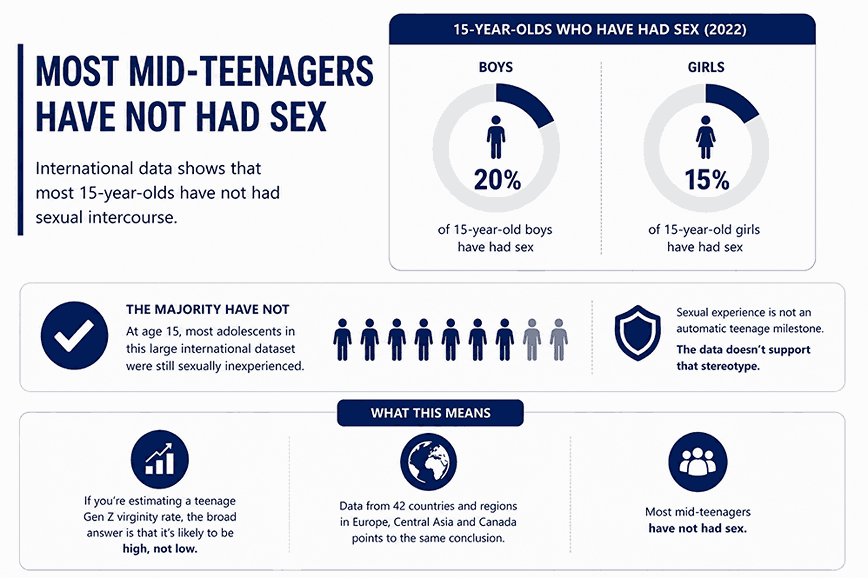
How many mid-teenagers have had sex?
Source: HBSC, University of Galway
Very early sexual debut is uncommon
Another useful measure is early sexual initiation. A 2025 peer-reviewed paper using HBSC data from 37 countries analysed more than 312,000 15-year-olds across survey waves from 2002 to 2022. It found that in 2022, just 4% reported first sexual intercourse before the age of 14.
That doesn’t tell us everything about Gen Z sexual behaviour, but it does tell us something important: very early sexual debut is relatively rare. The stereotype that today’s teenagers are all becoming sexually active younger and younger is not supported by this dataset.
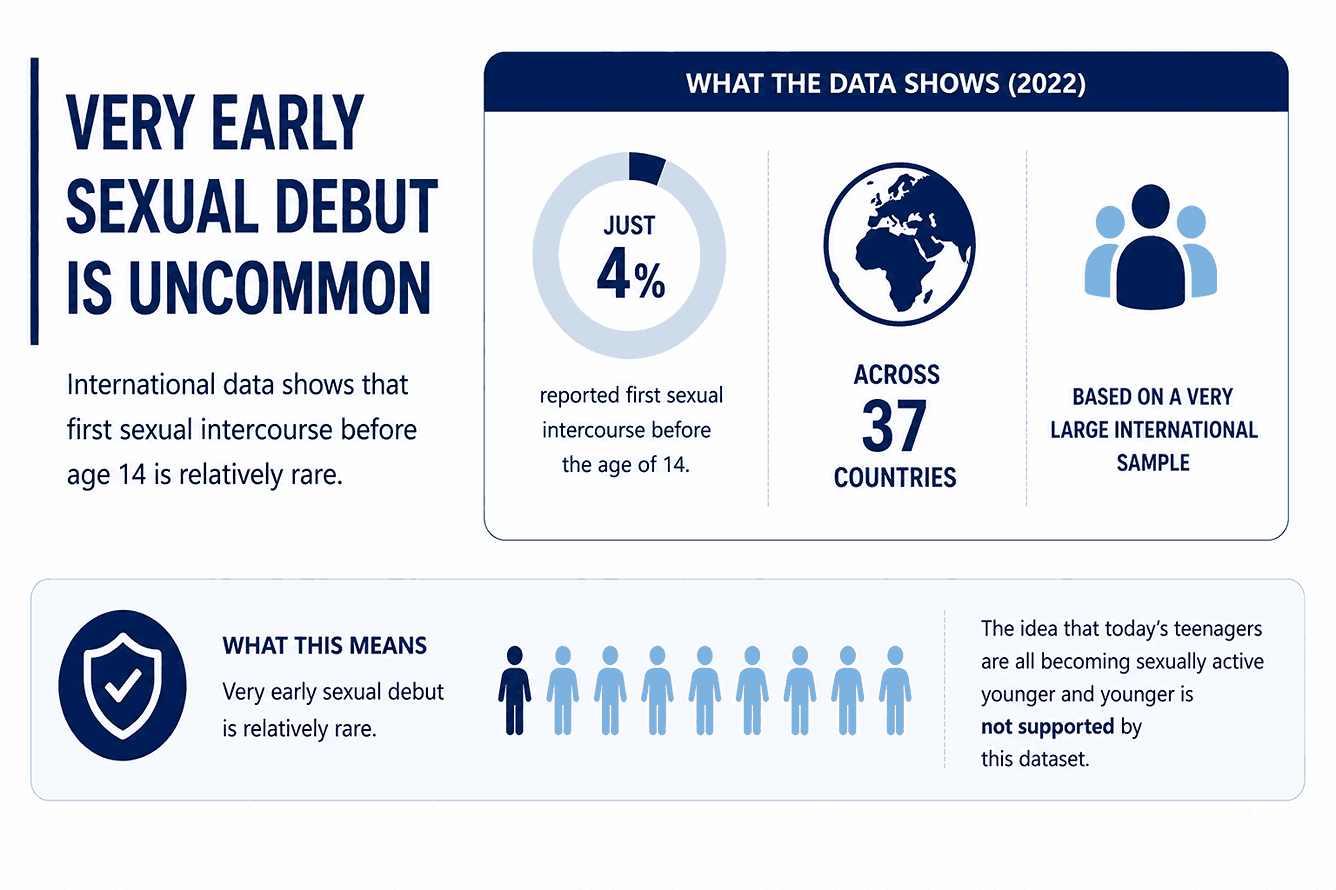
How many teens have sex before age 14?
Source: Int J Public Health
Some data suggests sex is happening later
There’s also evidence that, in at least some countries, first sex is happening slightly later. A Dutch population study covering people born between 1980 and 2004 estimated the median age at first intercourse for the 2020 generation at 18.17 years, and found a gradual rise in debut age across successive birth cohorts.
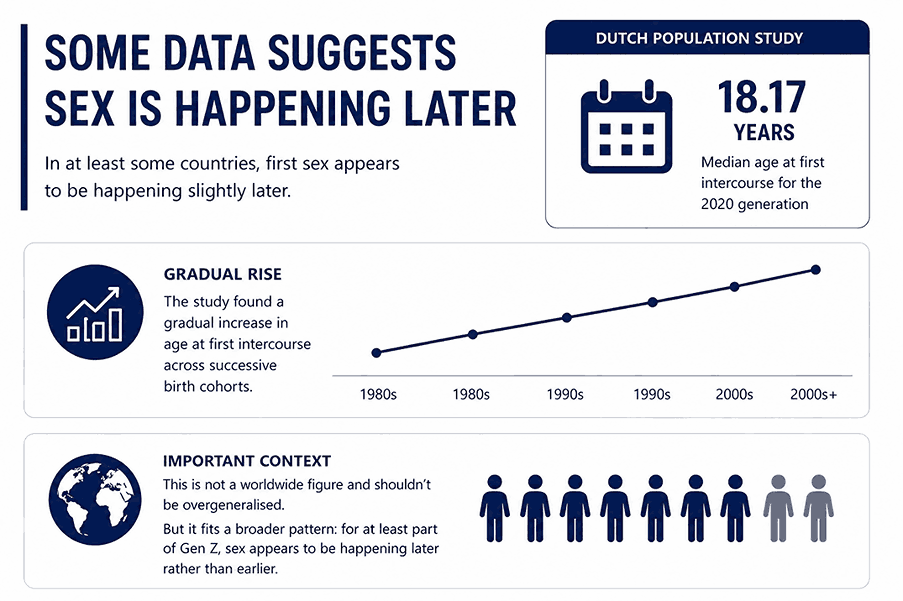
What does the data say about the age of first sex?
That is not a worldwide figure, and it should not be overgeneralised. But it fits the broader pattern seen in other recent work: for at least part of Gen Z, sex appears to be happening later rather than earlier.
Source: TBD
A noticeable minority of young adults are not sexually active each year
Once you move from teenagers to adults, the more useful question is often not “who is a virgin?” but “who is sexually inactive?”. France’s 2023 national sexuality survey is especially revealing here. It found a median age at first intercourse of 18.2 for women and 17.7 for men. It also found that amongst 18 to 29 year-olds, 79.4% of women and 74.1% of men had had sexual intercourse in the previous 12 months.
Flip those numbers around and a different story appears: roughly one in five young women and one in four young men in that age bracket reported no intercourse in the past year. That doesn’t mean all of them are virgins, but it does suggest that sexual inactivity amongst young adults is far from unusual.
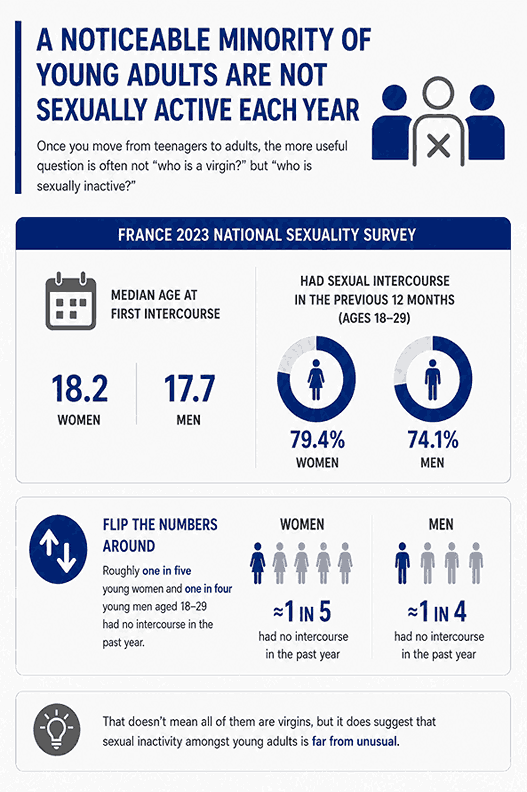
What percentage of young adults are not sexually active each year?
Separate US data on Gen Z sexual inactivity points the same way, suggesting that rising Gen Z sexlessness may also go hand in hand with higher levels of sexual inexperience at younger ages.
Source: CSF, 2023
So what is the Gen Z virginity rate?
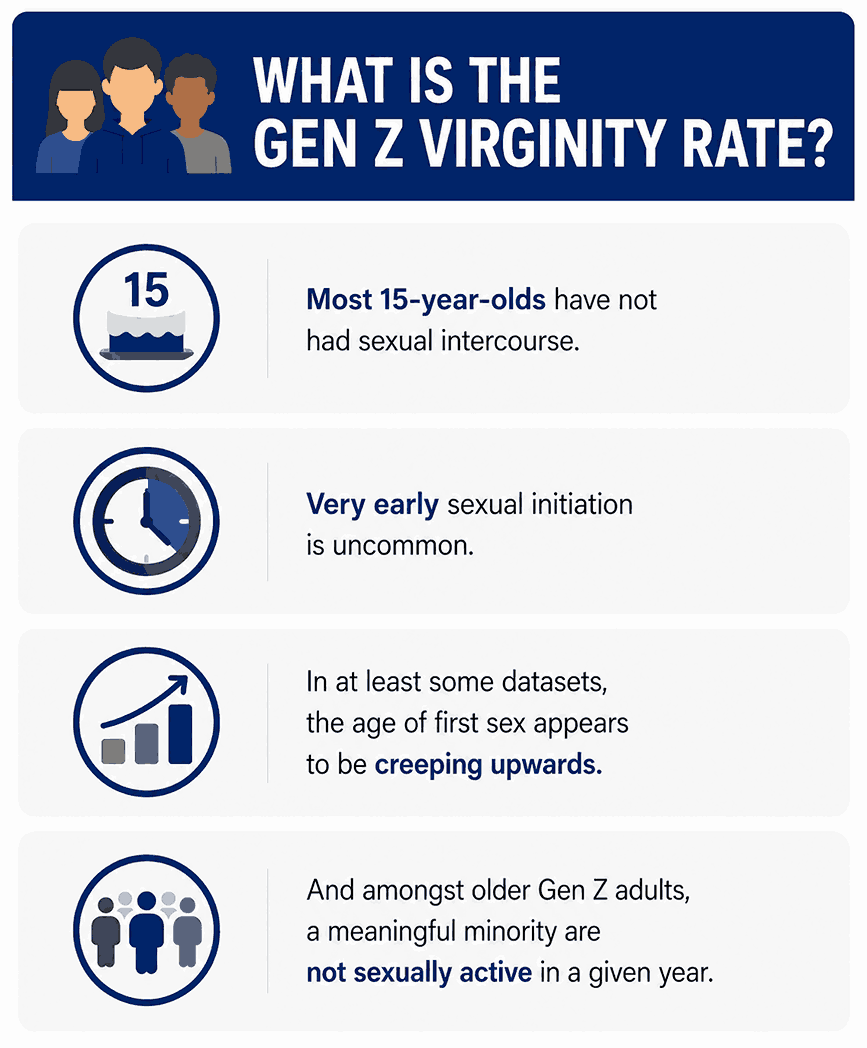
The honest answer is that there is no single Gen Z virginity rate figure. What the newer evidence does suggest is this:
Most 15-year-olds have not had sexual intercourse.
Very early sexual initiation is uncommon.
In at least some datasets, the age of first sex appears to be creeping upwards.
And amongst older Gen Z adults, a meaningful minority are not sexually active in a given year.
What is Gen Z virginity rate?
That is a much more accurate summary than any sweeping claim that Gen Z is all virgins or, on the other side, that sexual experience is universal by the late teens.
The bigger takeaway
The real story is not that Gen Z can be reduced to one dramatic statistic. It is that sexual timelines look more varied than many cultural stereotypes allow for.
A lot of teenagers are not yet sexually experienced. Some young adults are postponing sex, or simply having it less frequently. And despite constant talk about Gen Z hookup culture, the data suggests there may not be as much of one as people assume. The old idea that everyone follows the same path at the same age looks increasingly outdated.
That may be less clickable than the phrase “Gen Z virginity rate”, but it is much closer to what the data actually shows.