Sexlessness Statistics

Photo by Vitaly Gariev on Unsplash.
Sexlessness is no longer a niche or static phenomenon. The data increasingly suggests that it’s on the rise, particularly amongst younger adults.
That doesn’t mean every measure is moving in exactly the same way, or that every country is seeing the same trend at the same speed. But across several datasets, the broad direction is clear: a growing minority of people report going without sex for extended periods.
Even so, definitions still matter. There is no single universal meaning of “sexlessness”. Some surveys define it as having had no sex in the past year. Others mean having had no sexual partners in the past year. Others still refer to people with no lifetime sexual experience.
Those categories are not interchangeable, but they all point to the same broader social reality: more people, especially younger adults, are reporting more sexual inactivity relative to previous years.
The UK picture
In Britain, the best-known benchmark is still Natsal-3, the third National Survey of Sexual Attitudes and Lifestyles, carried out in 2010–2012. In that study, sexual inactivity was defined as reporting no oral, vaginal or anal intercourse in the previous year.
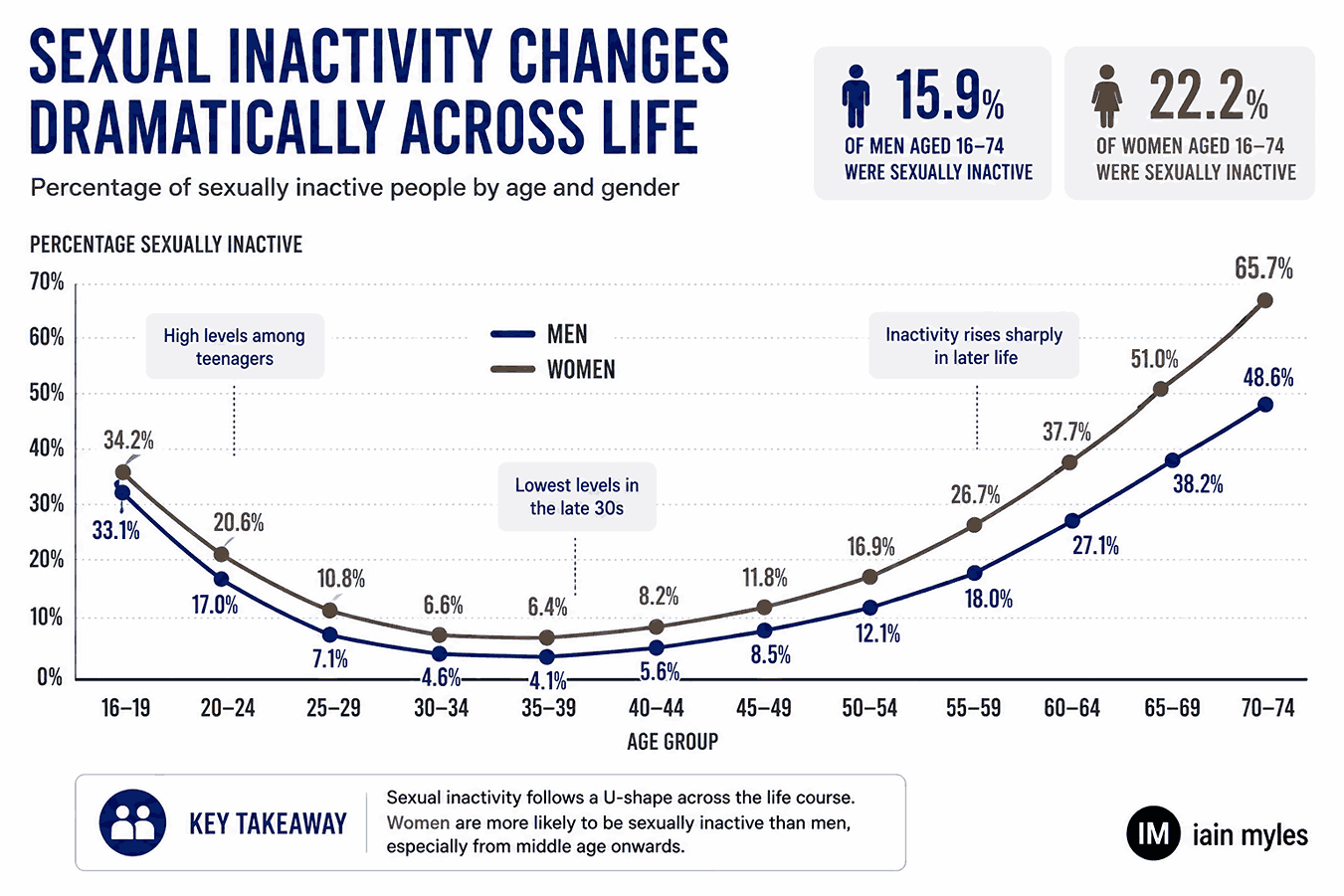
How sexual inactivity changes across different age groups?
Using that definition, 15.9% of men and 22.2% of women aged 16–74 were sexually inactive. The age pattern matters too: the study notes that sexual inactivity was more common in the oldest age groups, but it was also fairly common amongst younger adults, with roughly one in four to one in five 16–24 year-olds reporting sexual inactivity, compared with around one in ten amongst 25–34 year-olds.
Source: BMJ Open
The UK data timeline
That British benchmark is also much older than many readers realise. Natsal-4 fieldwork ran from September 2022 to April 2024 and reached a sample of about 19,000 people aged 16–59, but the official Natsal site says those datasets are only expected to reach the UK Data Archive in late 2026.
So if you’re looking for the most robust like-for-like British sexlessness statistics available right now, you are still largely looking at Natsal-3 figures rather than a fully released new wave. That means the strongest evidence for a clear rise comes more sharply from the US data, while Britain’s newest nationally representative figures are still pending full release.
Source: Natsal
Trends in the United States
The American data show the rise more clearly, with some of the most striking Gen Z statistics sitting within this broader pattern of sexual inactivity amongst younger adults.
A JAMA Network Open analysis of the General Social Survey found that amongst US men aged 18–24, the share reporting no sexual activity in the past year rose from 18.9% in 2000–2002 to 30.9% in 2016–2018.
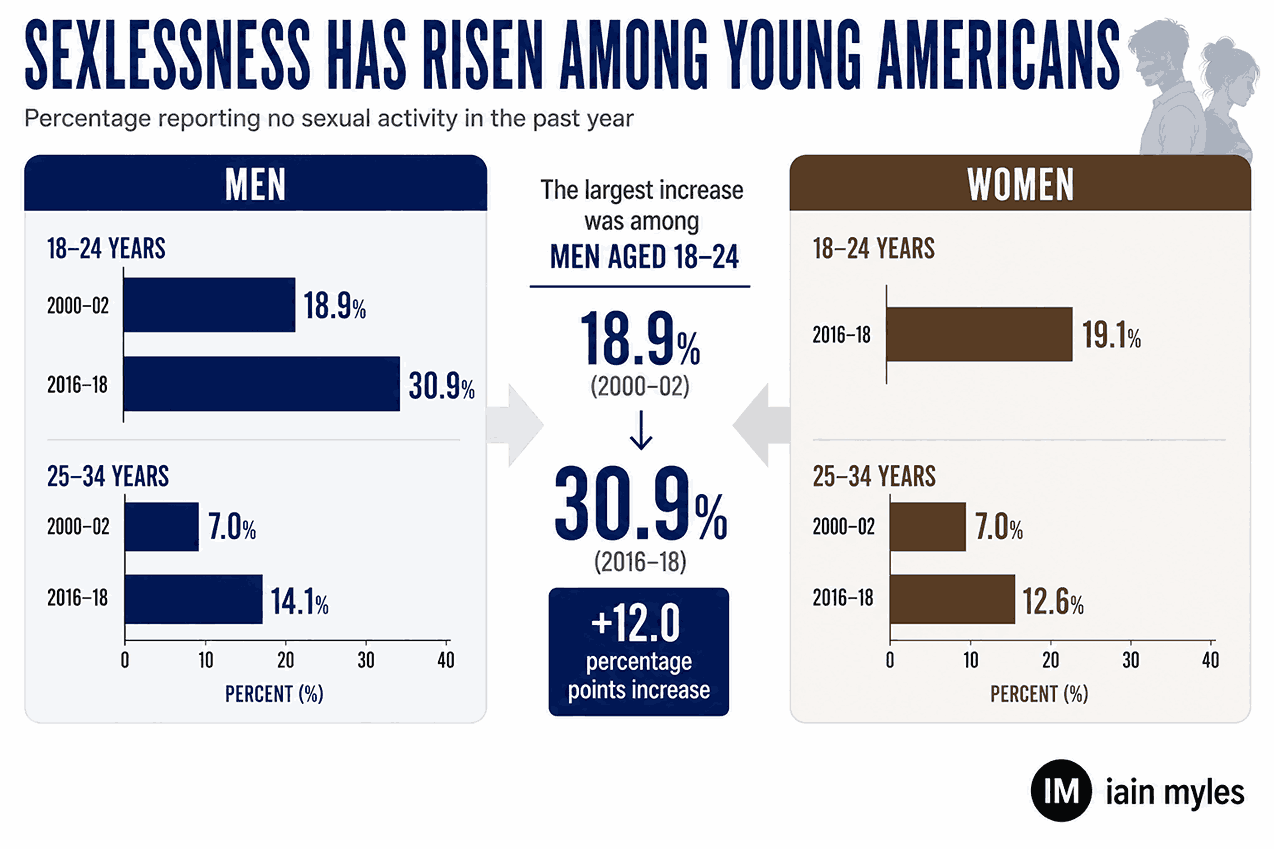
How sexlessness has risen among young Americans?
Amongst men aged 25–34, it rose from 7.0% to 14.1%, and amongst women aged 25–34, from 7.0% to 12.6%. In the 2016–2018 data alone, 30.9% of men and 19.1% of women aged 18–24 reported being sexually inactive in the past year.
That is why claims that sexlessness is rising are not simply media hype. In at least one major long-running dataset, the increase is substantial, especially amongst younger men.
Source: JAMA Network
Why comparisons are tricky
Even so, the British and American figures should not be treated as a straight international league table. The British study covered ages 16–74 and defined inactivity as no oral, vaginal or anal intercourse in the past year, while the US JAMA analysis covered ages 18–44 and used the General Social Survey’s question about how often people had sex in the last 12 months.
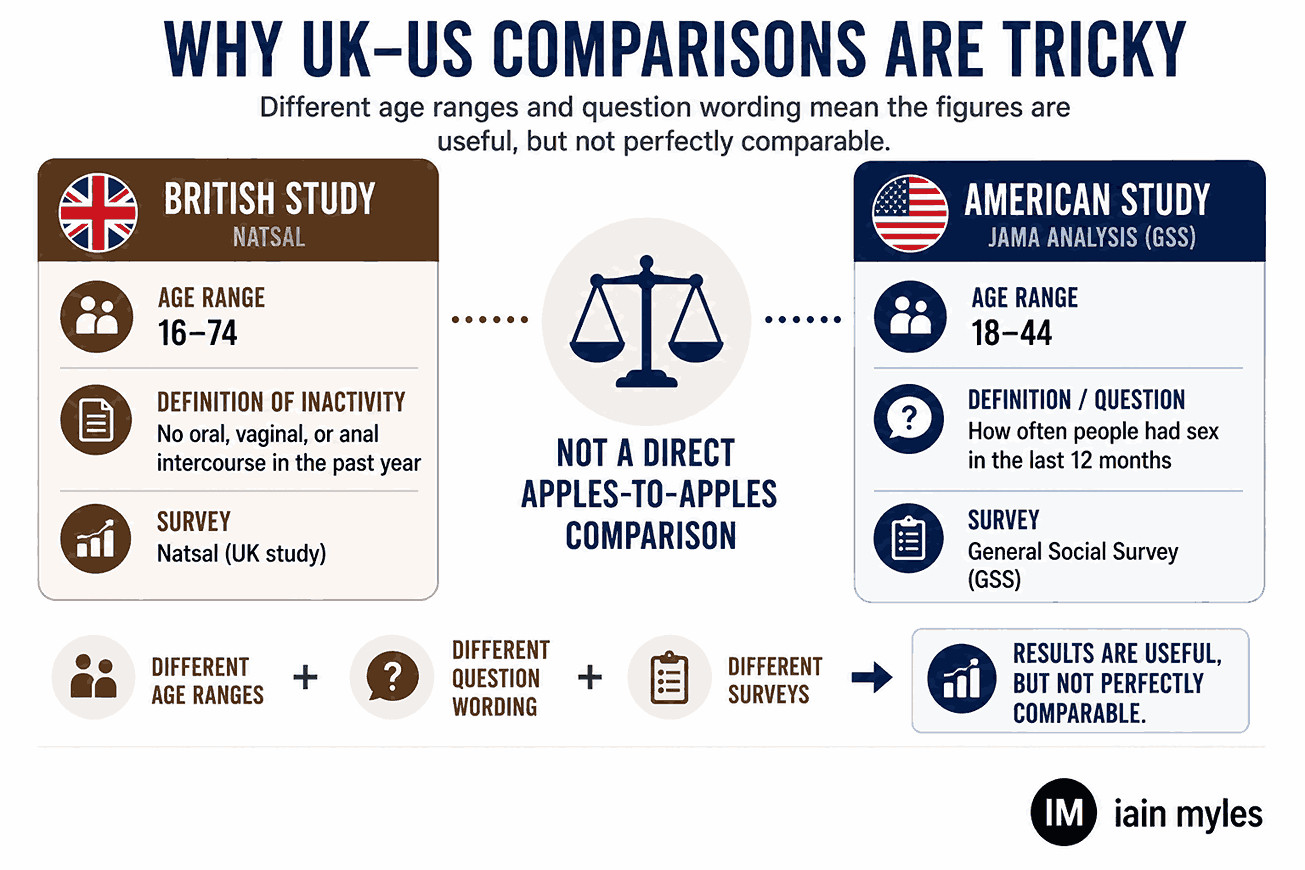
Why US and UK comparisons are tricky?
Different age ranges and different question wording mean the two sets of figures are useful, but not perfectly comparable. That matters because the rise may be real without being identical everywhere or under every definition.
Is sexlessness always unwanted?
Another point that gets lost in sensational coverage is that sexlessness is not always unwanted. In the British Natsal analysis, amongst sexually experienced people who were sexually inactive, 34.8% of men and 23.6% of women said they were dissatisfied with their sex lives.
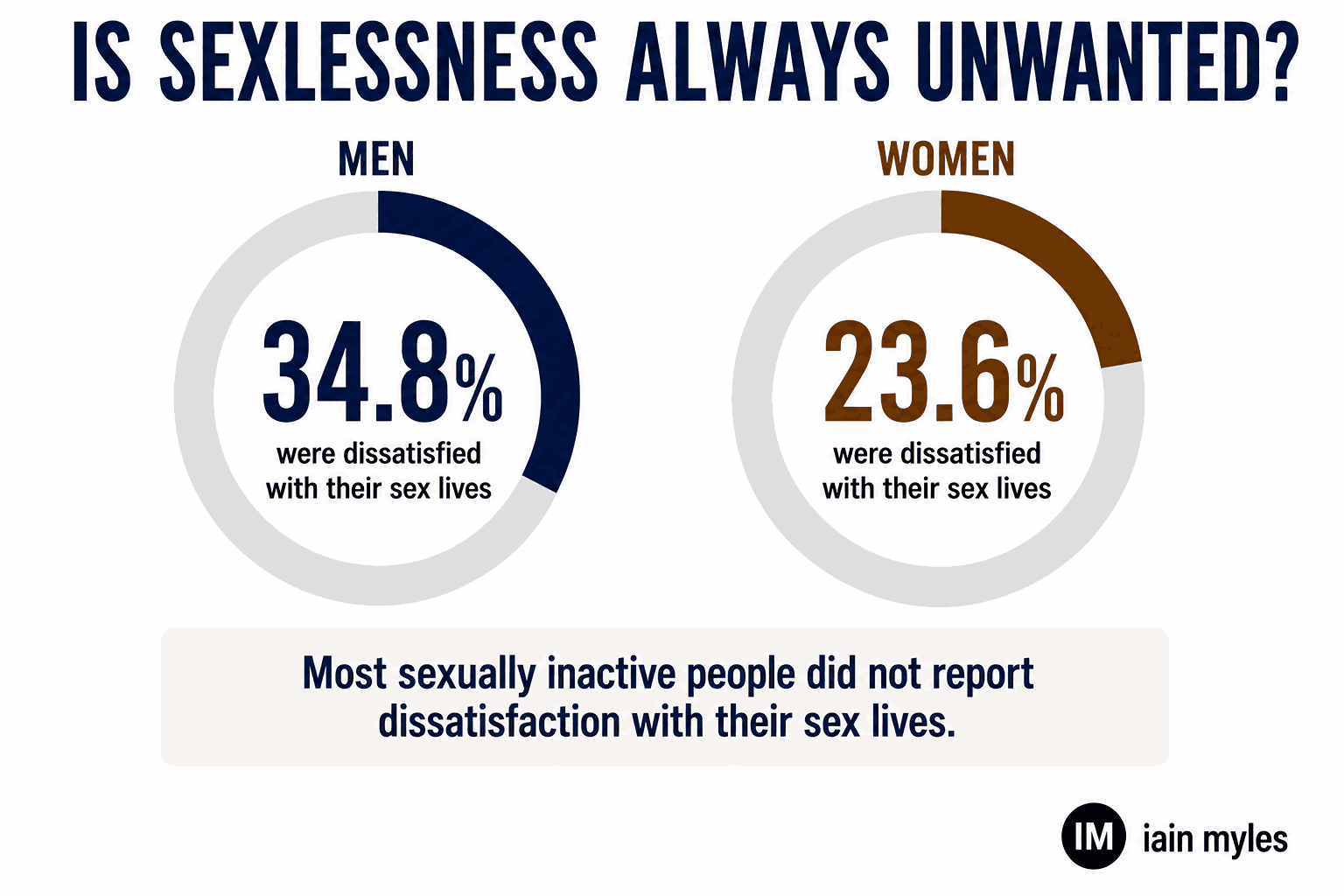
Is sexlessness always unwanted?
In other words, a sizeable minority were unhappy about it, but a majority did not report dissatisfaction. That matters because a rise in sexlessness does not automatically mean a rise in universal distress. It can also reflect singleness, low desire, health issues, faith, asexuality or simply a period of life when sex is not a priority.
In some cases, it may also show up within a sexless relationship, where emotional intimacy remains but sexual intimacy has faded.
Social and economic factors
The social patterning is revealing as well. In the US study, men with lower incomes and men in part-time work or with no employment were more likely to be sexually inactive, and students of both sexes were also more likely to report inactivity.
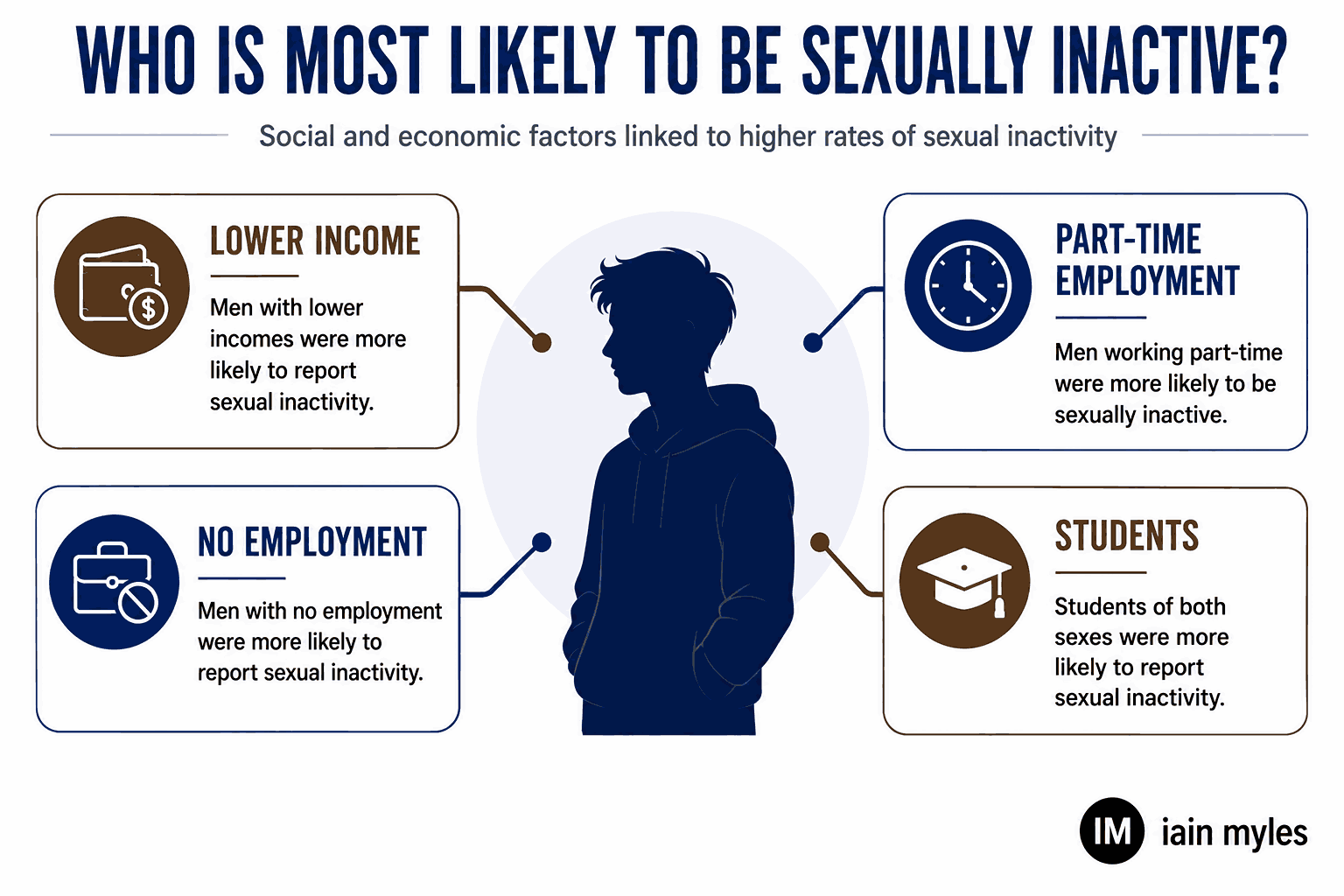
Who is most likely to be sexually inactive?
That does not prove cause and effect, but it does suggest that rising sexlessness is tied up with economics, work, relationship status and life stage, rather than being explained by one lazy catch-all story about “modern dating”.
What the statistics really mean
So what do sexlessness statistics actually tell us? First, a sizeable minority of adults report no sex in a given year. Secondly, there is evidence that this share has increased, especially amongst younger adults. Thirdly, age matters enormously, and the rise is not evenly distributed across every group.
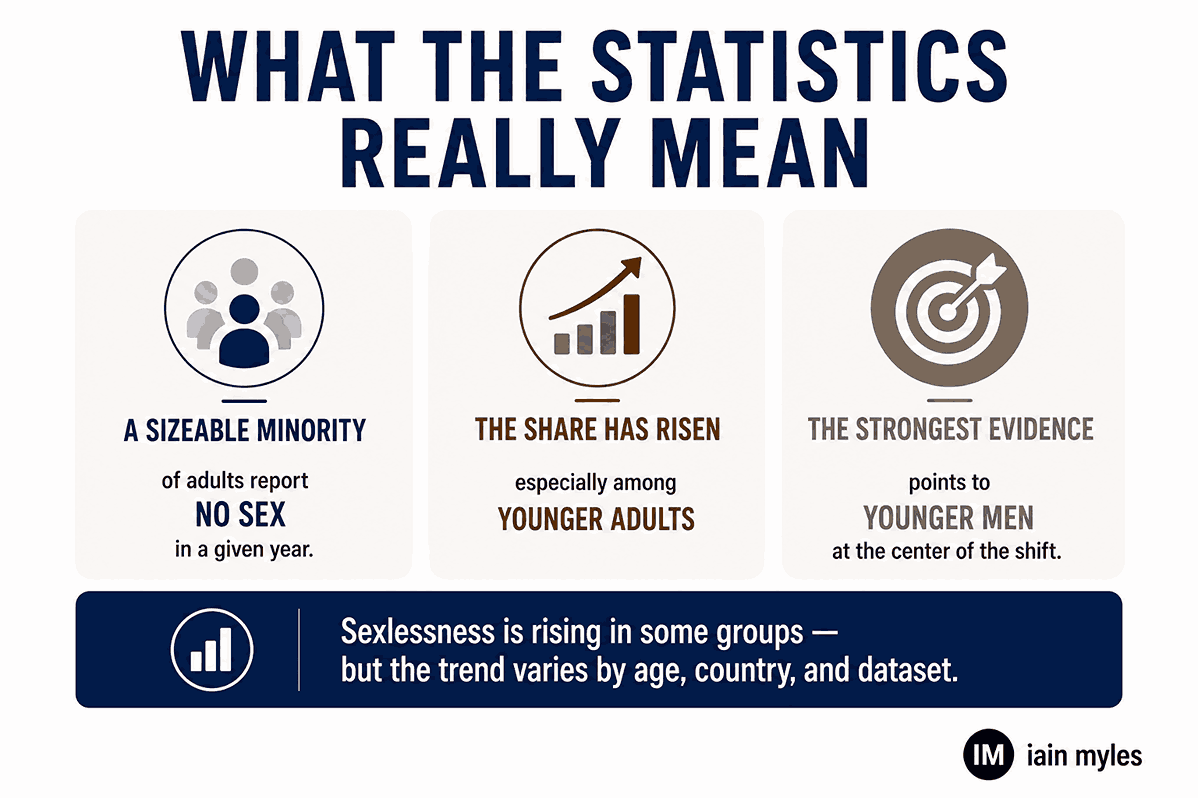
How do sexlessness trends differ across generations and groups?
Most importantly, the trend should be described accurately. The strongest available evidence suggests that sexual inactivity has risen in some major datasets, particularly in the United States, and that younger men are at the centre of that shift. Britain may well be experiencing something similar, but the newest nationally representative data are not yet fully available in a form that allows a clean like-for-like update.
A final note on interpretation
The safest rule for any writer is simple: say that sexlessness is rising, but explain what you mean by that. A dramatic number means very little on its own unless you also give the definition, age range and survey year.
Once you know whether a statistic refers to no sex in the past year, no partners in the past year, or no lifetime sexual experience, the trend becomes clearer and far more useful. The rise is real, but understanding how it is measured is what stops the story from becoming simplistic.